agent-recap
Six AI sessions going across two terminals and a Cursor window, and no way to tell which one still has work in it. The information exists — Claude Code, Cursor and VS Code Copilot Chat all keep session state on disk — but none of them show it to you, and certainly not across tools.
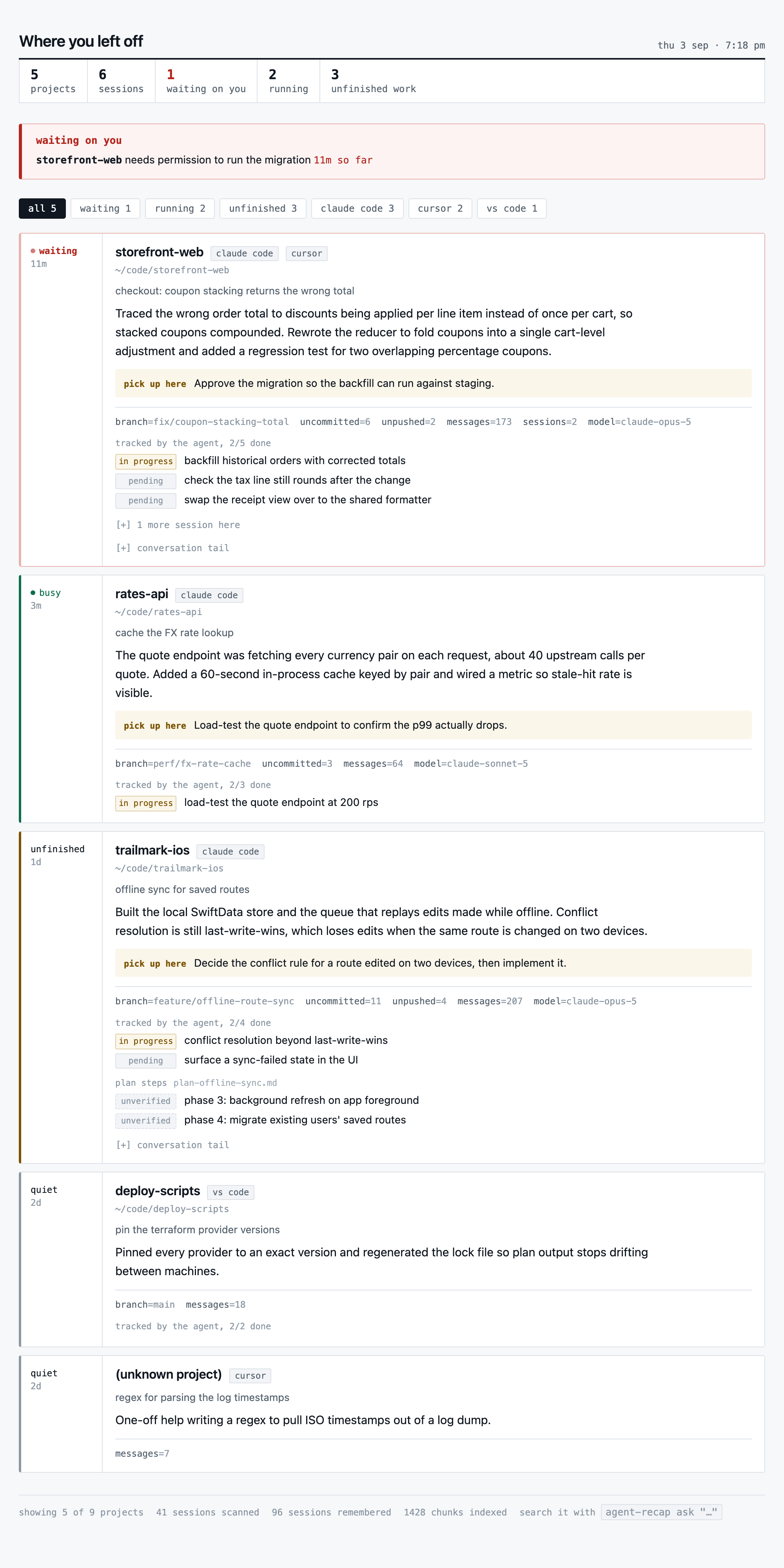
agent-recap reads all three read-only, works out where each project actually stands,
and writes one HTML page. It leads with what’s blocking you: an agent parked on a
permission prompt for 48 minutes gets a banner, because that’s the single most useful
thing the tool can tell you.
Everything runs locally against Ollama — qwen3:8b for summaries, nomic-embed-text
for embeddings. No API keys, no network calls.
The page: a waiting-on-you banner, then one card per project with its recap, a suggested next step, git state and any unfinished work. Sample data.
Reading other tools’ data
Claude Code lives in ~/.claude; Cursor keeps composer sessions in its global
state.vscdb; Copilot Chat is in VS Code’s workspaceStorage, in two different
formats. Each project directory contributes its git state.
Cursor and VS Code are usually running while this executes, so every connection is
opened with mode=ro, and the test suite asserts that writes and DDL are rejected
against the live databases. None of this storage is documented or stable, so each
source has a schema probe that reports through agent-recap doctor — drift should look
like a broken reader, not a quiet “no sessions found”.
Reported work versus inferred work
The card separates work an agent reported from work the tool inferred, and never
blends them. Cursor’s todo list and Copilot’s manage_todo_list are authoritative.
Claude Code has neither — its task tools go unused in practice and its plan documents
have no checkboxes. So plan steps get extracted from the Build order, Next steps
and Phase N sections of ~/.claude/plans/<slug>.md and judged against files on disk:
every file the step names exists means done, a missing file means outstanding, and a
step naming no files is outstanding and marked unverified.
That last case is why this isn’t a model call. With file evidence an 8B model adds nothing over the check itself; without it, the model was marking plainly-unstarted work as finished. The whole point is not forgetting things, so unknown resolves to shown. Only steps confirmed unfinished are allowed to influence the recap text — feeding unverified steps to the summarizer made it narrate completed work as still in progress.
Memory
Sessions are chunked into SQLite + sqlite-vec so you can ask about them later:
agent-recap ask "what was I doing with the rates API?", answered with citations.
Raw transcripts are deliberately not embedded — Claude Code alone is ~200 MB of mostly tool output. Each session yields a handful of chunks instead: a summary, the last message from each side, open todos, and any plan document. The plan documents turn out to be the most valuable material, since they hold the decisions and the rationale.
Expiry is tiered rather than age-based, because a project you paused two months ago may be exactly the one with unfinished work. Pinned and has-an-open-todo never expire; a project whose directory is gone drops immediately however recent it is.
Excerpts are scrubbed before storage, before the model, and before rendering — API
keys, tokens, JWTs, private key blocks, KEY=value assignments. Field names survive so
the recap still reads sensibly. This matters more for the store than the page, since the
store outlives the session that produced it.
Speed
Summarizing is the slow part, so each session is fingerprinted on its content and
unchanged sessions reuse their cached recap and skip re-embedding. Cold run over 36
sessions is ~50s; a warm run with nothing changed makes no model calls at all;
--no-llm does 67 sessions over 90 days in ~3.5s.
Sessions are grouped by project, not by session, because “where did I leave off on X” is a question about a project. Here that turned 38 sessions into 18 projects.
76 tests. macOS only — every storage path it reads is macOS-specific.